
Hello! I have been grappling with procrastination for over 30 years, which inspired me to research this area to overcome procrastination for both myself and others. My broader interest lies in understanding how humans make decisions and exploring ways to improve our decision-making processes.
Highlights:
The perceived value of objects tends to increase simply due to ownership, which can create a gap between the selling price and buying price. Our research demonstrates that this gap increases when transactions between sellers and buyers are scheduled in the future.
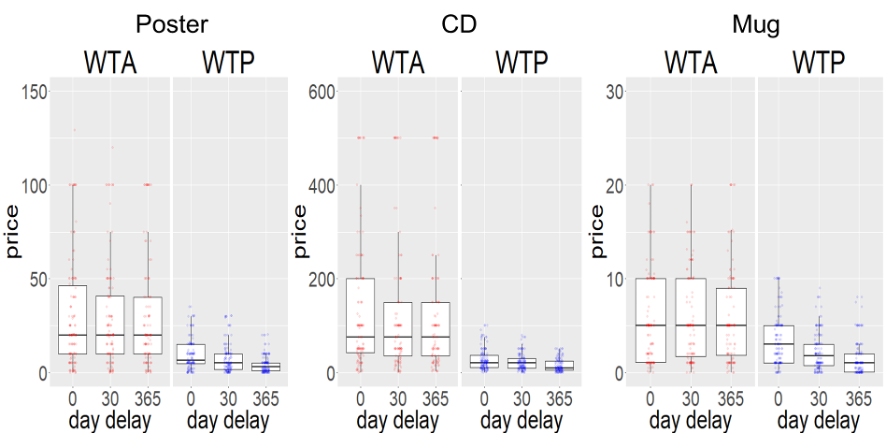
Figure 1 illustrates the preference patterns we observed: the seller’s willingness to accept remains relatively constant, while the buyer’s willingness to pay is consistently discounted for future transactions across three items—a poster, an autographed CD, and a mug.
Figure 1. Selling (WTA) and Buying (WTP) Prices of the Three Items across Time Scenarios (Experiment 3).
Implications:
Many daily transactions are deferred to the future. For instance, you might purchase an item online and receive it later, agree to sell something on an online flea market now and make the transaction at a later date, or pay in advance to book a hotel, among other scenarios.
Our findings suggest that the gap between the seller’s willingness to accept and the buyer’s willingness to pay increases when the transaction is delayed. Consequently, agreements on transactions are less likely to be reached when they are scheduled for the future.
Highlights:
Previous research consistently identified differences in time preferences between decisions involving effort and those involving money. However, it was unclear whether these differences stemmed from the types of the outcomes or the associated pleasurable or unpleasurable experiences.
In response, we developed a novel two-stage experiment using a 2 x 2 design to compare outcomes (money and effort) across domains (pleasant and unpleasant). This method allowed for the incentivization of all decisions, including those involving future monetary losses. Our study reveals sign-dependent preferences, indicating varying levels of impatience depending on whether the experiences are pleasant or unpleasant, and whether they relate to monetary or effort-based decisions.
Highlights:
This study demonstrates that when merely framing intertemporal questions as either investments or loans, while maintaining identical total outcomes, time preferences are influenced. This phenomenon is due to the tendency to ignore common payments between choices.
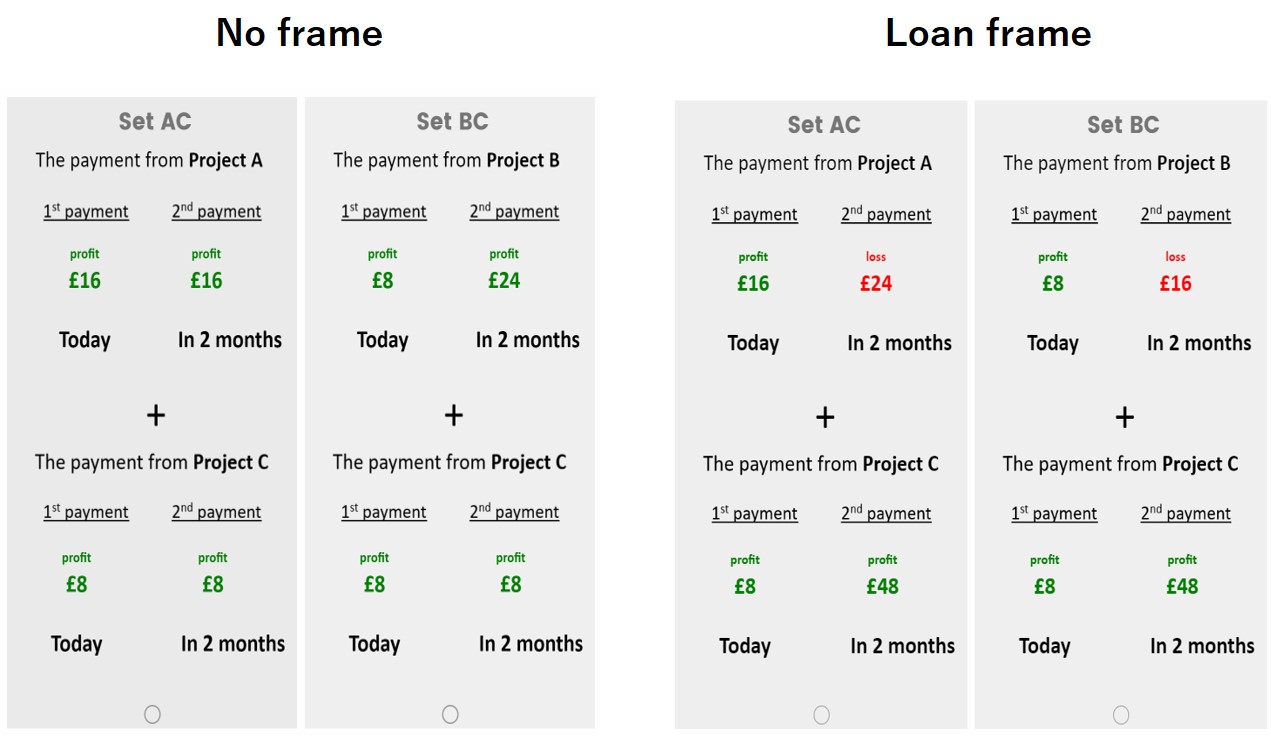
Figure 2 displays screenshots of the first questions in the No frame and Loan frame treatments (Study 1). The total outcomes are the identical between these two frames (£24 today and £24 in 2 months in total for the left option, and £16 today and £32 in 2 months in total for the right option). Subjects tended to ignore the common payments between the options when making decisions, resulting in different preferences between the two frames.
Figure 2. The Screenshot of the Question (No frame, Gain section (on the left); Loan frame (on the right) Study 1).
Implications:
Our findings have practical implications, showing that time preferences can be influenced without changing total outcomes. This insight is applicable across various fields. For example, consider two hypothetical stocks Stocks A and B, which yield identical total returns. Both generate identical dividends, whereas their prices fluctuates differently over time. Our findings suggest that individuals can make irrational decisions because they tend to ignore the identical dividends component and focus solely on variable stock price.
Highlights:
This research examined the impacts of peer effects through experiments resembling online English vocabulary learning platforms. Low perseverance in learning partners negatively influenced learners; these learners quit studying earlier and displayed lower performance.
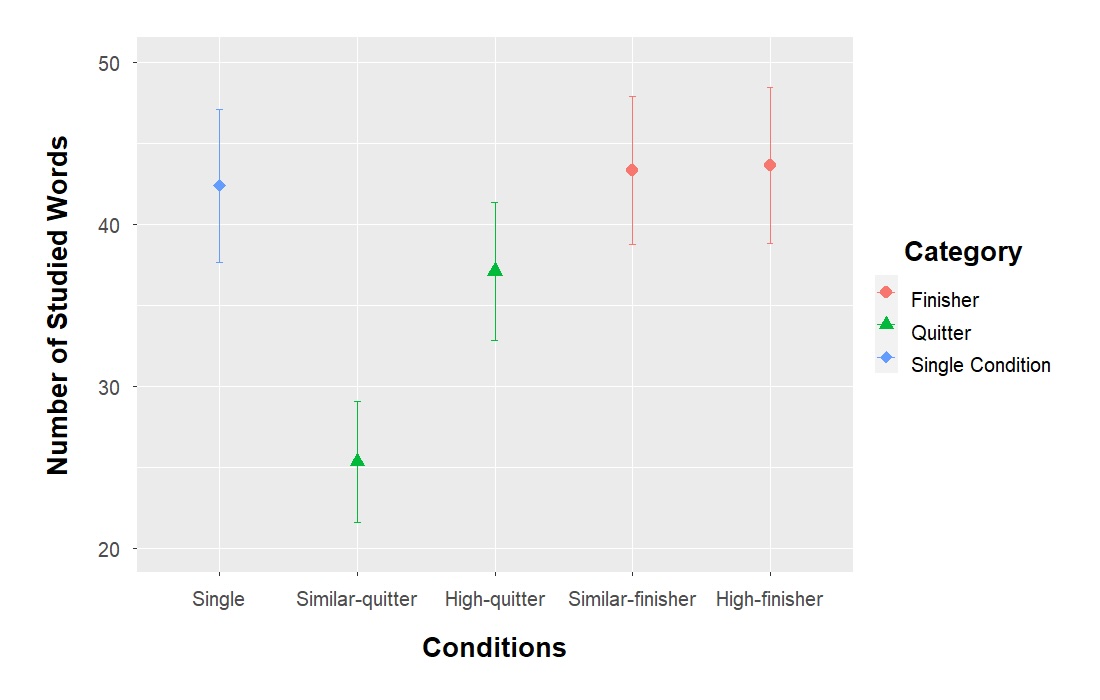
In the experiment, some leaners studied English vocabulary either individually (Single condition) while others studied with a learning partner.
Figure 3 shows the number of studied words in Study 1. Compared to the Single Condition, the number of studied words was significantly lower leaners had a similarly skilled and low-perseverance partner (Similar-quitter condition).
Further analysis indicated that the negative peer effects predominantly originated from participants with lower levels of motivation. Additionally, it was shown that social proximity could foster positive effects when peers possess similar skills and higher perseverance levels.
Our findings suggest that the strategic pairing of learners with appropriate partners is crucial for diminishing negative peer effects and enhancing positive peer influences.